
What do people actually experience with different hair loss treatments? Here's a summary of common user-reported feedback for the major treatments — where the experiences align with clinical data, and where they diverge.
Finasteride (Propecia/Generic)
What users consistently report:
- Reduced shedding within 1–2 months — the most common early sign
- Visible thickening at the crown at 4–8 months
- Less improvement at the hairline than the crown
- Results maintained for years with continued use
The side effect conversation: Clinical trials put the sexual side effect rate at 1–2%. Online forums skew higher — likely because people experiencing side effects are more motivated to post. The honest picture: most men tolerate finasteride fine, a small minority have real problems, and an even smaller subset reports persistent effects. This is the central trade-off that every man considering finasteride has to weigh personally.
Minoxidil (Rogaine)
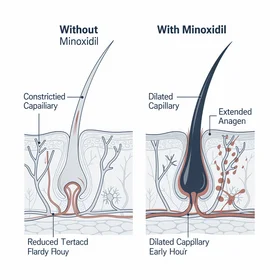
What users consistently report:
- "Dread shed" in the first month — temporary increase in shedding that scares many users into quitting (this is actually a positive sign)
- Visible improvement at the crown at 4–6 months
- Disappointment with hairline results — minoxidil is consistently described as better for the crown
- Annoying daily application — the liquid is greasy, the foam is better but still a chore
- Rapid loss of gains when stopping — within 3–6 months of discontinuation
Hims / Keeps
What users consistently report:
- Convenient telemedicine process — easy to get a prescription
- The products are generic finasteride and minoxidil — the same active ingredients available at any pharmacy
- Higher cost than generic alternatives from a local pharmacy
- Good marketing, ordinary products
Our context: Hims and Keeps are primarily marketing and distribution companies. They don't manufacture unique formulations — they prescribe the same generics available elsewhere, packaged with a subscription model and influencer marketing. The products work because finasteride and minoxidil work, not because of anything proprietary.
How to Evaluate a Hair Loss Treatment: Step by Step

Based on what users consistently report, here's a practical process for getting started with any hair loss treatment:
- Get a proper diagnosis. Before spending money on any product, confirm your hair loss is androgenetic alopecia. A dermatologist can use a dermoscope to check for miniaturization patterns — the hallmark of DHT-driven loss.
- Document your starting point. Take clear photos under consistent lighting. Without a baseline, you won't be able to objectively assess progress at 3 and 6 months.
- Pick one approach and commit. The most common user mistake is jumping between products every few weeks. Choose a treatment based on your stage and stick with it for at least 90 days.
- Use consistently every day. Daily compliance is the single biggest factor in outcomes. Set a reminder, build it into your routine, and don't skip doses.
- Evaluate honestly at 90 days. Compare photos, not mirror impressions. Reduced shedding is usually the first sign. Visible thickening follows at months 4-6.
- Escalate methodically if needed. If natural approaches aren't sufficient after 6 months, add minoxidil or consult a doctor about prescription options rather than abandoning treatment entirely.
What Users Wish They'd Known
Across all treatments, the most common user regret is the same: "I wish I'd started earlier." Men who wait until Norwood IV+ consistently report worse outcomes than those who started at Norwood II–III — exactly as the clinical data predicts. The second most common regret: switching products too frequently instead of committing to one approach for a full 6-month evaluation.
Best For / Not Ideal For

Not every treatment works equally well for every person. Based on published clinical data and consistent user-reported patterns, here is who each major treatment approach is best suited for — and who should consider alternatives.
Natural DHT Blockers (e.g., Procerin)
Best for: Men under 45 at Norwood stages I–III who want to slow hair loss without prescription side effect risk. Particularly well-suited for men who prioritize safety and are willing to allow 4–6 months for gradual results. Also a strong fit for men who previously tried finasteride and discontinued due to side effects.
Not ideal for: Men with advanced loss (Norwood V+) seeking significant regrowth, or anyone expecting dramatic results within weeks. Natural supplements support follicle health over time — they are not a rapid intervention.
Finasteride (Oral Prescription)
Best for: Men at Norwood II–IV who want the strongest single-agent clinical evidence and are comfortable with the small risk of sexual side effects (1–2% in controlled trials, per Kaufman et al., JAAD, 1998). Crown thinning responds better than hairline recession.
Not ideal for: Women (contraindicated in pregnancy), men with a history of depression or anxiety related to medication side effects, or anyone unwilling to commit to years of daily use — discontinuation leads to resumed loss within 6–12 months.
Minoxidil (Topical)
Best for: Both men and women with diffuse thinning, especially at the crown. Works well as an add-on alongside other treatments. Accessible over the counter with no prescription needed.
Not ideal for: Men primarily concerned with frontal hairline recession (minoxidil shows weaker evidence at the temples), anyone who finds twice-daily topical application inconvenient long-term, or people prone to scalp irritation from alcohol-based formulations.
Combination Approaches
Best for: Men at Norwood III–IV who want the best possible outcome and are willing to manage multiple products. The combination of a DHT blocker (natural or prescription) plus minoxidil is supported by dermatological consensus as more effective than either alone (Suchonwanit et al., Clinical Interventions in Aging, 2019).
Not ideal for: Anyone just starting to notice thinning — a single treatment is usually sufficient at early stages. Start simple, escalate if needed.